
You’re not “crazy,” “toxic,” or “paranoid” because you can’t stop checking. You are experiencing a real stress response to betrayal—a state where your mind is urgently searching for certainty to prevent being blindsided again.
This plan was built for you if:
◇ You feel on “high alert,” constantly scanning your environment for signs of dishonesty or infidelity.
◇ You feel a compulsive need to check their phone, social media, or location just to get a moment of relief.
◇ You find yourself interrogating every small detail of a story, looking for holes or hidden meanings.
◇ You become extremely jealous of anyone who gets close to your partner, from coworkers to old friends.
◇ You’ve started withdrawing and putting up walls, or trying to tightly control the relationship out of fear.
◇ You doubt your own judgment and keep asking, “How did I not see this coming?”.
This guide supports stabilized recovery: heal the emotional wound first, then rebuild your discernment.
◇ A structured trust-recovery protocol built around one non-negotiable principle: Self-trust comes before shared trust. Every time.
◇ A repeatable progression designed to restore internal order—step by step: stabilization → processing → self-trust → trust ladder → sustained security
◇ A practical system meant to be used in real moments—especially when suspicion spikes and anxiety starts overriding your judgment.
◇ A decision-protection framework that helps you pause, verify, and protect your heart from impulsive actions and future regret.
◇ It is not therapy, diagnosis, or a replacement for professional mental-health care—and it should not be used as a substitute for clinical support.
◇ It is not a “blind forgiveness” strategy, a reconciliation playbook, or a persuasion system—and it does not teach manipulation.
◇ It is not a spiritual shortcut, affirmation collection, or motivational hype—and it does not promise instant emotional erasure.
◇ It does not push decisions or tell you what to choose—it reduces emotional noise so your decision becomes clear, grounded, and truly yours.
Your goal isn’t to trust them right now. Your goal is to trust yourself—so your next decision is clean.
◇ Reclaiming mental composure and physical safety when your emotional foundation collapses
◇ Disrupting the cycle of intrusive thoughts and hypervigilance using the Reality-Check system
◇ Establishing non-negotiable boundaries that halt further pain and prevent reactive decisions
◇ Rebuilding your internal compass and exiting the spiral of self-doubt and guilt
◇ Why open access and proactive honesty are mandatory for short-term regulation and long-term repair
◇ Re-entering commitment through a measured, evidence-based progression that protects your heart
Most people describe the relief as immediate: the hypervigilance fades, and your own judgment becomes your strongest ally again.
Instant access • One-time payment — $39
Immediate recovery support designed for high-stress moments—when you feel consumed by suspicion, the urge to check, or an emotional spiral. This isn’t just information. It’s a structured protocol you can deploy the moment a trigger starts overriding your peace.
✦ 30-Day Recovery Roadmap (structured for momentum)
✦ Betrayal Wound Stabilization: Emotional first-aid
✦ Immediate Triage: Rules for the high-risk discovery window
✦ The Trust Ladder: An evidence-based rebuilding system
✦ Trigger Log & Reality-Check stabilization tools
✦ Transparency & Accountability agreement templates
✦ Discernment Guide: Differentiating red flags from trauma echoes
✦ Private online access — bookmark and return anytime
› Secure payment via Stripe (takes under a minute)
› Receive your private access link instantly
› Open the guide immediately—no waiting, no appointments
This plan is designed for individuals seeking clarity over suspicion after the traumatic experience of romantic betrayal.
This is for you if:
◇ you want a logical roadmap to replace the chaos of constant hypervigilance
◇ you notice overwhelming urges to check devices or locations just for temporary relief from anxiety
◇ you care about protecting your self-worth and sharpening your future discernment
◇ you feel trapped in a loop of interrogation and overthinking every past detail
◇ you want a private, autonomous system to rebuild safety at your own pace
This guide supports people who want to stabilize their nervous system first, before making life-altering decisions they might later regret.
This is not for you if:
◇ you’re only looking for “blind trust” or a quick return to naive innocence
◇ you expect the deep-seated pain of betrayal to vanish without consistent personal effort
◇ you’re currently facing a severe mental-health crisis that requires clinical intervention or emergency care
This is a trust-rebuilding framework designed to foster discernment—not a substitute for professional clinical treatment
This entire process is built for absolute ease of use—ensuring you have immediate support without any technical stress.
Following your purchase:
✦ Your secure access link is delivered to you instantly
✦ Access the full protocol online with no large files to download
✦ Simply bookmark your private page to return to the tools at any time
✦ No account registration or password setup is ever required
Take a look at the real pages of the Trust Again Protocol before you start.
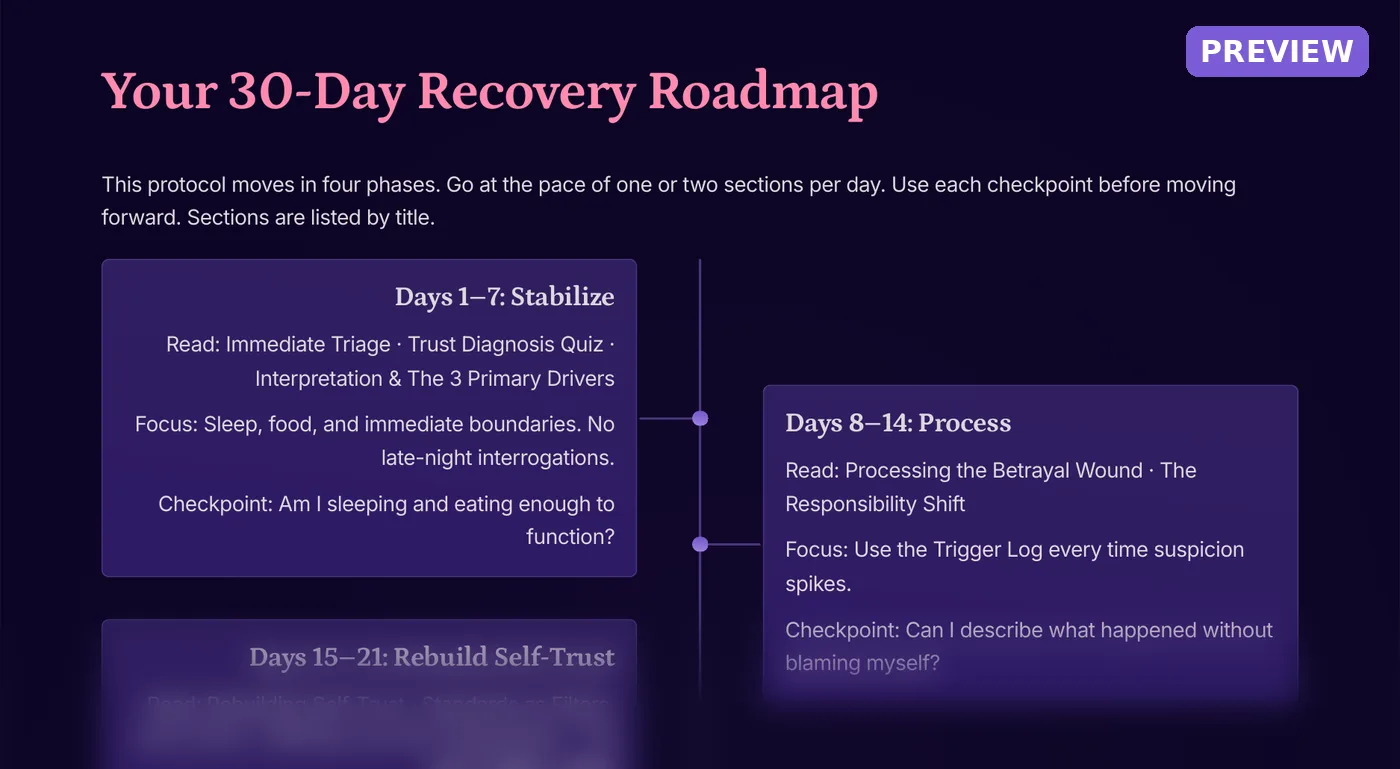
The 30-Day Recovery Roadmap: four phases, from stabilizing to choosing your path, each with a checkpoint.
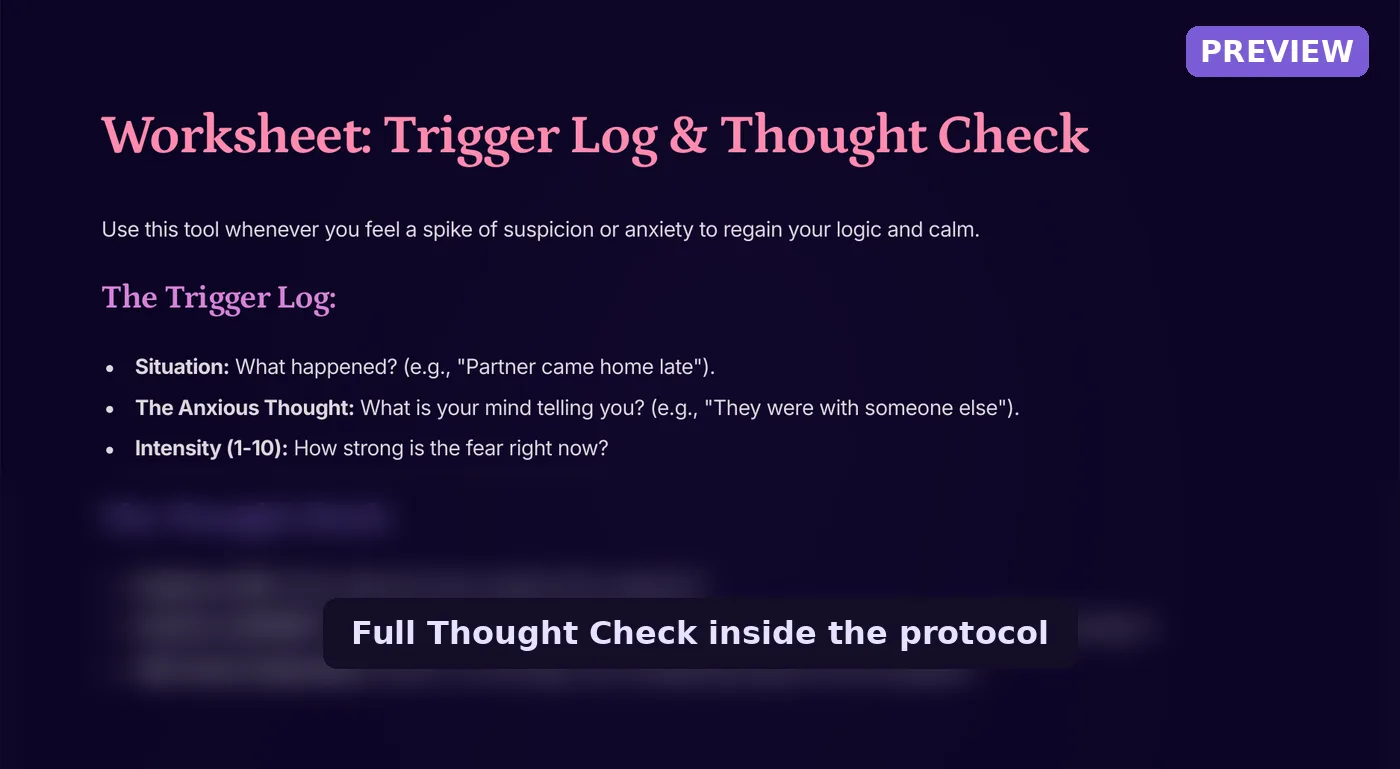
The Trigger Log & Thought Check: a written tool to use whenever suspicion or anxiety spikes.
When suspicion spikes, you won’t be guessing: you’ll have a roadmap, a log, and a calm way back to your own judgment.
It is a structured recovery protocol you execute step-by-step. This is not a book for passive reading or a series of generic videos. It is a system where you diagnose your trauma drivers, set non-negotiable standards, and follow a concrete roadmap to regain control. If you are trapped in a cycle of suspicion, this moves you from hypervigilance into discernment and safety.
Because compulsive checking is a safety signal problem, not a lack of willpower. When your trust is shattered, your nervous system stays on “high alert” to prevent being blindsided again. This protocol provides a structured Trigger Log and Thought Check to stabilize your anxiety. Instead of scanning for “clues” in a panic, you use an evidence-based system to verify reality and calm your mind.
Trust is not a “leap of faith”; it is a gradual ladder built on consistent data. Each step is secured by consistent actions, not just grand promises. You will learn how to monitor specific behaviors—Reliability, Openness, and Vulnerability—so that trust is never blind again, but clear-eyed and verified.
The goal is to help you decide from a place of power, not panic. If you are stuck between “moving on” and “staying,” the protocol provides objective filters like the Best Friend Test. You will also learn to differentiate between genuine accountability and defensive red flags. This helps you determine if your partner is truly trustworthy based on their current actions.
General advice often focuses on “forgiving,” but this protocol focuses on Self-Trust and Boundaries. Talking doesn’t stop a trauma response, but structure does. This guide is different because it uses:
A Trust Diagnosis to identify your specific trauma driver.
A Non-Negotiable Blueprint to define your exit strategy.
Transparency Agreements to create immediate safety.
A 30-Day Roadmap that prioritizes your dignity above all else.
The protocol includes a specific Doubt & Trigger Protocol for those exact moments. You will have an “Emergency Triage” system and a Trigger Log to use the moment panic hits. It teaches you to label the feeling as a “trauma echo” rather than a current threat, giving you the tools to ground yourself without needing external reassurance.
Yes, because it begins with Immediate Triage and Stabilization. The first phase of the roadmap requires zero major decisions—only physical grounding and setting basic boundaries. It is designed for someone who is in “survival mode”. The workload is broken down into small, manageable steps that protect your energy while rebuilding your core.
Most people feel a shift as soon as they implement the “Responsibility Shift”. Relief comes when you stop carrying the responsibility of their choices and start focusing on your own Daily Dignity Check. By day 30, you will have moved from a state of compromised functionality to a state of sustained security and self-reliance.